The Philosophy of Schrödinger's Cat (And Why Our Site Is Named After It)

Jordan is a writer for schrodingers.cat. They did a PhD on disagreement and moral reasoning at McGill and still get excited when someone changes their mind in a good faith debate. When not writing, they're probably reading sci-fi or losing at board games. (Our bylines are fictional—like the cat in the box. No authors or cats were harmed. See our About page.)
Our blog authors are fictional—a thought experiment in multiple voices. Why we do this →
Key points
What Schrödinger's cat really means, why Erwin Schrödinger was a philosopher as well as a physicist, and how that thought experiment inspired schrodingers.cat.
People search for Schrödinger's cat philosophy because the thought experiment is famous but the point of it is easy to miss. Was the cat really alive and dead at once? Was Schrödinger trolling physicists? And why would a philosophy site name itself after it? This article is for anyone who wants the philosophy behind the cat, and how it shows up here on schrodingers.cat.
What is the philosophy of Schrödinger's cat? In short: Erwin Schrödinger, an Austrian physicist and one of the founders of quantum mechanics, proposed the scenario in 1935 to illustrate a problem. Quantum theory seemed to say that until you look, a system could be in a "superposition" of states. Scale that up to a cat in a box with a poison trigger, and you get something absurd: a cat that's somehow both alive and dead until someone opens the box. Schrödinger wasn't saying cats do that. He was saying: if your interpretation of quantum mechanics implies that, you'd better either fix the interpretation or live with the weirdness. So the philosophy of Schrödinger's cat is about observation, certainty, and what we're allowed to say before we look. Below: the setup in plain language, why Schrödinger was a philosopher as well as a physicist, and how we use the idea on this site (including our about page and our learning paths).
What is Schrödinger's cat? The setup
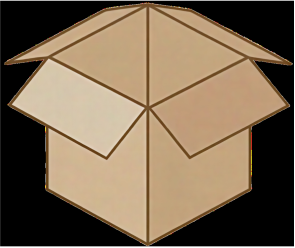
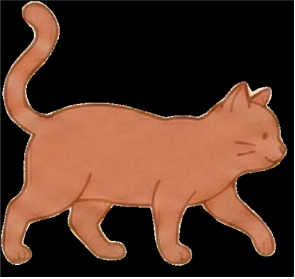
Imagine a closed box. Inside: a cat, a tiny bit of radioactive material, a Geiger counter, and a vial of poison. If the atom decays, the counter fires and the poison kills the cat. If it doesn't, the cat stays alive. According to one way of reading quantum mechanics, the atom is in a superposition of "decayed" and "not decayed" until it's observed. So before you open the box, the formalism sometimes gets described as: the cat is both alive and dead.
Schrödinger's point was that this is ridiculous if you take it literally. No one thinks a real cat is in two states at once. So either (a) the "superposition" language shouldn't be applied to big, everyday things like cats, or (b) we need a better story for what observation does, or (c) we just accept that the theory is weird. The Schrödinger's cat thought experiment is a tool for thinking about the boundary between quantum description and ordinary experience. For more on philosophy of science and how we reason about evidence, see philosophy of science and logic and argumentation on schrodingers.cat.
Erwin Schrödinger as philosopher
Schrödinger is best known for the equation that bears his name and for the cat. But he also wrote on philosophy: the nature of mind, the relation between life and physics, and the interpretation of quantum theory. He wasn't only doing calculation; he was asking what the world is like and what we can know. So when we talk about Erwin Schrödinger philosopher, we mean someone who used physics to push on traditional philosophical questions about reality, observation, and consciousness.
His book What Is Life? (1944) tackled the border between physics and biology and influenced how people thought about genes and order in living systems. He also wrote on the unity of consciousness and the problem of the self. So the philosophy of Schrödinger's cat sits next to a broader body of work: a physicist who kept asking what it all means. If you like big, boundary-crossing questions, the philosophy map and learning paths on schrodingers.cat cover plenty of thinkers who mix science and philosophy.
Why we named the site after the cat
Schrodingers.cat is a philosophy and critical-thinking site. We offer learning paths, Socratic dialogue with historical figures, a forum, and argument mapping. The name isn't random.
On our about page we say it explicitly: the bylines on our blog (Jack Willis, Lily Nguyen, Jordan Ellis, and others) are fictional. We use them as a thought experiment: multiple "voices" without pretending they're real people. That's a direct nod to Schrödinger's cat. The cat in the box is a device for thinking clearly about possibility and observation; our fictional authors are a device for giving the blog variety and perspective without false claims. So the philosophy of Schrödinger's cat—the idea of a thought experiment that clarifies rather than deceives—is built into how we present the blog.
The site is also about holding multiple possibilities in view until you decide. You don't have to pick one learning path and never look back. You can browse the philosophy map, try the path quiz, or jump into a Socratic dialogue and see where the questions lead. In that sense, the "box" is your own exploration: you open it by choosing what to read, what to argue, and what to question. We don't pretend there's one right path; we try to make the options clear and let you look inside.
Key philosophical ideas in the thought experiment
Uncertainty and incomplete knowledge. Before you open the box, you don't know whether the cat is alive or dead. So the scenario highlights the difference between (1) the state of the world and (2) what you're in a position to say. A lot of philosophy is about when we're entitled to claim we know something. The Schrödinger's cat thought experiment makes that vivid: the formalism says one thing, common sense says another, and the gap is where philosophy of science does its work.
Observation and "collapse." In many versions of quantum mechanics, measurement—an observer interacting with the system—plays a special role. That raises philosophical questions: Does looking "create" the outcome or just reveal it? Schrödinger didn't answer that; he used the cat to show how odd the standard story could get. If you're interested in how observation and evidence work in science, epistemology and philosophy of science on schrodingers.cat go deeper.
Superposition as a metaphor. Outside physics, "superposition" sometimes gets used loosely: many possibilities in play until something is decided. We're not claiming that's what Schrödinger meant. But the image—multiple states coexisting until an observation or a choice—fits how we think about learning. You have many possible paths; which one you're "on" depends on what you do next. So the philosophy of Schrödinger's cat connects to how we design the site: multiple paths, multiple voices, and you as the one who opens the box by engaging.
Where to go deeper
You don't need to be a physicist to care about the philosophy of Schrödinger's cat. It's about clarity, possibility, and the limits of what we can say before we look. On schrodingers.cat you can: (1) read the about page for the story behind the name and the fictional bylines; (2) try learning paths on epistemology, philosophy of science, or logic; (3) use the philosophy map to see who else worked at the border of science and philosophy; (4) join the forum or start a Socratic dialogue and put your own views to the test. The cat is a reminder that thought experiments are for thinking. We try to do the same with paths, dialogue, and argument.
Frequently Asked Questions
What is the philosophy of Schrödinger's cat?
The philosophy of Schrödinger's cat is the set of conceptual issues the thought experiment raises: the role of observation in quantum mechanics, the line between quantum description and everyday experience, and what we can say about a system before we measure it. Schrödinger used the cat to criticize the idea that superposition applies unproblematically to macroscopic objects like cats.
Was Erwin Schrödinger a philosopher?
Erwin Schrödinger was primarily a physicist (Nobel Prize, 1933), but he also wrote on philosophy: the interpretation of quantum mechanics, the nature of life (What Is Life?), and consciousness. So he is often treated as a philosopher of science and a thinker who crossed between physics and philosophy. The cat is one example: it's a philosophical argument done with a scenario instead of equations.
Why is the site called schrodingers.cat?
We named the site after the thought experiment because we use a similar idea for our blog: the bylines are fictional, like the cat in the box—a deliberate thought experiment to give the blog multiple voices without pretending they're real people. The site also emphasizes multiple possibilities (learning paths, dialogue, argument) until you "open the box" by choosing what to read and how to engage. See our about page for the full story.
Conclusion
The philosophy of Schrödinger's cat isn't just a meme. It's about observation, certainty, and the limits of formalism when you scale it up to the world we live in. Erwin Schrödinger was a physicist who did serious philosophical work, and the cat is one piece of that. On schrodingers.cat we take that spirit literally: fictional bylines as a thought experiment, and learning paths, Socratic dialogue, and argument mapping as ways to hold possibilities open until you look. If you want to open the box yourself, start with the about page, then learning paths or the philosophy map.
Summary. Schrödinger's cat: a thought experiment about superposition and observation. Schrödinger: physicist and philosopher. Our site: named after the cat, with fictional blog authors as our own thought experiment and multiple paths for you to explore. Go deeper with about, paths, and philosophy map.
About → · Learning paths → · Philosophy map → · Path quiz →
Key takeaway: The philosophy of Schrödinger's cat is about what we can say before we look. We use that idea in our name and in how we run the blog. Explore it with paths and dialogue on schrodingers.cat.
Start learning philosophy for free
Guided paths, Socratic dialogues, and argument mapping—no signup required.
Browse learning pathsMore from the blog
Blog · Browse free philosophy learning paths · Join the forum · Argument Cartographer · Philosophy map