
History of Philosophy: An Overview of the Main Periods and Traditions

Jack is a writer for schrodingers.cat. He holds a DPhil in Philosophy from the University of Oxford and has taught critical thinking and argument mapping at the LSE and in prison education programmes. He's obsessed with making philosophy legible and fun—and still thinks the best argument is the one that changes someone's mind over a pint. (He has been told this is "very British.") (Our bylines are fictional—like the cat in the box. No authors or cats were harmed. See our About page.)
Our blog authors are fictional—a thought experiment in multiple voices. Why we do this →
Key points
A concise overview of the history of philosophy: ancient, medieval, early modern, modern, and contemporary periods, plus global traditions and where to go deeper.
The history of philosophy is the story of how people have asked the big questions—what is real? what can we know? how should we live?—and built on (or argued with) earlier answers. If you’ve ever wanted a history of philosophy timeline in plain language—who came when, what each period cared about, and how it all connects—this article is for you.
What is the history of philosophy? In short: it’s the record of philosophical inquiry over time: the main periods, movements, and figures, and how ideas spread and changed. You don’t need to memorize dates; you need a map of the territory so you can see where a thinker or a text fits. Below: a history of philosophy overview—ancient, medieval, early modern, modern, and contemporary—plus a note on global traditions and how to explore further with learning paths and the philosophy map on schrodingers.cat.
Why the history of philosophy matters
Philosophy through the ages isn’t just a list of names. It’s a way to see how questions get refined, how one answer leads to the next, and how different cultures have tackled the same kinds of problems. Knowing a bit of philosophy history helps you read primary texts: you see who a thinker is responding to, what was in the air, and why they framed the question that way. It also corrects the myth that philosophy is only Western—traditions in India, China, the Islamic world, Africa, and elsewhere have their own long history of philosophy. For a visual sense of who thought where and when, see our philosophy map; for a focused intro to one period, see philosophy of the ancient Greeks.
Ancient philosophy (roughly 6th c. BCE – 6th c. CE)
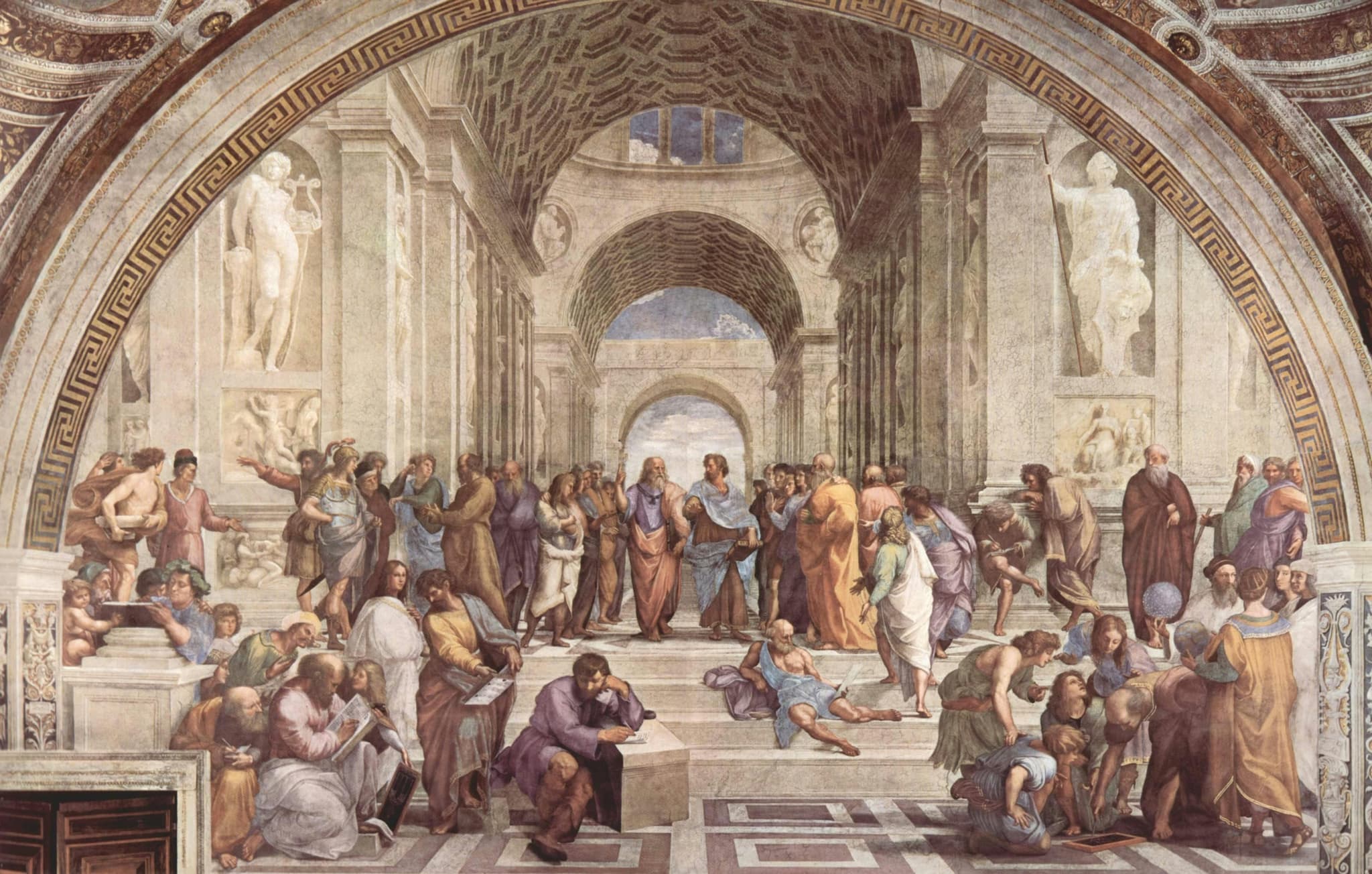
The history of philosophy in the West is often said to begin in the Greek-speaking world. Pre-Socratics (e.g. Thales, Heraclitus, Parmenides) asked what the world is made of and what is fundamental. Socrates (c. 470–399 BCE) turned the focus to how we should live and what we can know; we know him mainly through Plato (c. 428–348 BCE), who founded the Academy and developed the theory of Forms. Aristotle (384–322 BCE), Plato’s student, founded the Lyceum and systematized logic, metaphysics, ethics, and politics. After Aristotle, Hellenistic schools—Stoics, Epicureans, Skeptics—focused on how to live well in an uncertain world. So the history of philosophy in antiquity is: nature (pre-Socratics), then soul and virtue (Socrates, Plato, Aristotle), then practical wisdom (Hellenistic). For more on ancient Greek philosophy, see philosophy of the ancient Greeks and Aristotle and the golden mean.
Medieval philosophy (roughly 5th–15th c. CE)
In the history of philosophy, the medieval period in Europe and the Islamic world saw philosophy in dialogue with religion. In the Islamic world, thinkers in Baghdad and elsewhere translated and commented on Greek texts; Avicenna (Ibn Sīnā) and Averroes (Ibn Rushd) developed metaphysics, epistemology, and philosophy of mind. In Europe, Scholasticism combined Aristotle with Christian theology; Thomas Aquinas is the best-known figure. So philosophy history in this period is often about faith and reason, the existence of God, and the nature of the soul. The same centuries also saw rich traditions in India, China, and elsewhere—so philosophy through the ages is never only one story. For paths on medieval or Islamic philosophy, browse learning paths or the philosophy map.
Early modern philosophy (roughly 16th–18th c.)
The history of philosophy in the early modern period is dominated by questions about knowledge and the mind. Descartes (1596–1650) asked what we can know with certainty and gave the “cogito” (I think, therefore I am). Hume (1711–1776) pushed empiricism and skepticism about causation and the self. Kant (1724–1804) tried to reconcile rationalism and empiricism and set the agenda for much later philosophy. In the same period, Francis Bacon (1561–1626) championed observation and experiment—so philosophy history here includes the rise of modern science as well as epistemology and metaphysics. For more on Bacon, see philosophy bacon; for Descartes and Hume, see learning paths and the path quiz.
Modern and contemporary philosophy (19th c. onward)
In the history of philosophy, the 19th and 20th centuries saw a split often described as analytic vs continental. Analytic philosophy (dominant in the English-speaking world) emphasized logic, language, and argument; continental philosophy (phenomenology, existentialism, critical theory) emphasized history, experience, and the limits of reason. Key figures range from Kierkegaard and Nietzsche to Frege, Russell, Wittgenstein, Heidegger, Beauvoir, and Rawls. Philosophy through the ages in this period is also increasingly global: postcolonial, African, Latin American, and other traditions have become part of the conversation. For a short intro to the analytic side, see analytic tradition; for philosophy beyond the West, see philosophy beyond Western thought.
Global traditions in the history of philosophy
Philosophy history is not only Western. Indian philosophy (e.g. Nyāya, Vedānta, Buddhist logic) has a long history of philosophy of its own; so does Chinese philosophy (Confucianism, Daoism, Mohism), Islamic philosophy (from the translation movement in Baghdad onward), and African philosophy (including contemporary and decolonial work). A history of philosophy timeline that only goes Greece → Rome → Europe → America is incomplete. On schrodingers.cat, the philosophy map shows thinkers across traditions and time so you can see where different history of philosophy threads sit; learning paths include global and non-Western traditions. For more, see philosophy beyond Western thought.
How to explore the history of philosophy
You don’t need to read the whole history of philosophy to benefit. Pick one period or one figure that interests you. Use the philosophy map on schrodingers.cat to see who thought where and when—you can scrub a timeline and filter by tradition. Then use learning paths to go deep on a thinker or a question; the path quiz suggests a path from your interests. If you want a visual, chronological sense first, read History of philosophy: how to learn it with a map; if you want the story in words, you’re in the right place. Philosophy through the ages is a scaffold—use it to find where you want to dig in.
Frequently Asked Questions
What is the history of philosophy?
The history of philosophy is the record of philosophical inquiry over time: the main periods (ancient, medieval, early modern, modern, contemporary), movements, and figures, and how ideas spread and changed. It includes Western and global traditions and helps you see where a thinker or text fits.
What are the main periods in the history of philosophy?
A common history of philosophy timeline divides into: ancient (Greek and Roman, roughly 6th c. BCE–6th c. CE), medieval (Europe and Islamic world, roughly 5th–15th c.), early modern (16th–18th c., e.g. Descartes, Hume, Kant), and modern/contemporary (19th c. onward, including analytic and continental traditions). Global traditions (Indian, Chinese, Islamic, African, etc.) have their own periodizations.
Where can I learn the history of philosophy?
Use the philosophy map on schrodingers.cat to see thinkers across time and place; then use learning paths to go deep on a period or figure. See also history of philosophy: how to learn it with a map and philosophy of the ancient Greeks.
Conclusion
The history of philosophy is the story of how the big questions have been asked and answered—and argued with—over time. You don’t need to learn it all; you need a map so you can see where a thinker fits and then go deep. Use this overview as a scaffold, then explore with the philosophy map, learning paths, and path quiz on schrodingers.cat.
Summary. History of philosophy: ancient, medieval, early modern, modern, and contemporary periods, plus global traditions. Use the philosophy map and learning paths on schrodingers.cat to explore further.
Philosophy map → · Learning paths → · Path quiz → · Ancient Greek philosophy → · History of philosophy with a map →
Key takeaway: The history of philosophy is the story of the big questions over time. Use the philosophy map and learning paths on schrodingers.cat to see who thought where and when—then go deep on one period or figure.
Start learning philosophy for free
Guided paths, Socratic dialogues, and argument mapping—no signup required.
Browse learning pathsMore from the blog
Blog · Browse free philosophy learning paths · Join the forum · Argument Cartographer · Philosophy map