Jean-Paul Sartre (1905–1980) begins Being and Nothingness (1943) with an ontological distinction that underwrites everything else in his existentialist philosophy. The universe contains two fundamentally different kinds of being: the in-itself (en-soi) and the for-itself (pour-soi).
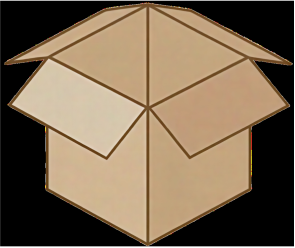
The in-itself is the mode of being of things, stones, tables, trees, brute matter. The in-itself simply is what it is. It coincides completely with itself. It has no inner distance from itself, no self-awareness, no capacity to question what it is or become something different. A rock does not choose to be a rock; it is rock through and through, with total density, no gaps.
The for-itself is the mode of being of consciousness, the human being. And here the structure is entirely different. Consciousness is characterized by nothingness (le néant): a perpetual inner distance from itself. Consciousness is always aware of itself, but that awareness means consciousness can never simply coincide with what it is. There is always a gap between what I am (my facticity, my past, my situation, my body, my history) and what I am not-yet (my possibilities, my future, what I am projecting toward). This gap is freedom. You cannot close it. Consciousness is the being by which nothingness comes into the world.
This is why Sartre says: existence precedes essence. For things, essence precedes existence, a knife is designed with its purpose in mind before it is made; it has an essence (cutting) before it exists. For humans, existence precedes essence: you exist first, arrive in the world without a predetermined purpose or nature, and only become who you are through your choices. As Sartre put it in his famous 1945 lecture: "Man first of all exists, encounters himself, surges up in the world, and defines himself afterwards."
The implication is total and inescapable: you are condemned to be free. Not free in the comfortable sense that you have a range of pleasant options. Free in the vertiginous sense that there is nothing, no God, no human nature, no social role, no past decision, that determines what you must do next. Every moment, you are choosing. Even the refusal to choose is a choice. Even full conformity to what society expects is a choice, the choice to conform.
Man is condemned to be free; because once thrown into the world, he is responsible for everything he does. It is therefore absurd that we are born, and it is absurd that we die.
— Jean-Paul Sartre, Being and Nothingness (1943); elaborated in 'Existentialism Is a Humanism' (1945)
The anguish (angoisse) that accompanies this recognition is not pathological, it is the appropriate response to seeing your situation clearly. Sartre distinguishes anguish from fear: fear has a specific object (I fear this speeding car); anguish has no object, it is the experience of being the source of your own choices with no guarantee and no escape. You feel anguish most acutely at what Sartre calls vertigo: standing at the edge of a cliff, you feel not just fear of falling but the unnerving awareness that you could jump. Nothing prevents you. Your own freedom opens like an abyss beneath your feet.
Quick reflection
Sartre says anguish is not fear but the awareness that you are always the source of your choices with nothing compelling you. Can you recall a moment of this specific kind of anguish — not fear of a consequence but unease at your own absolute freedom to choose?